







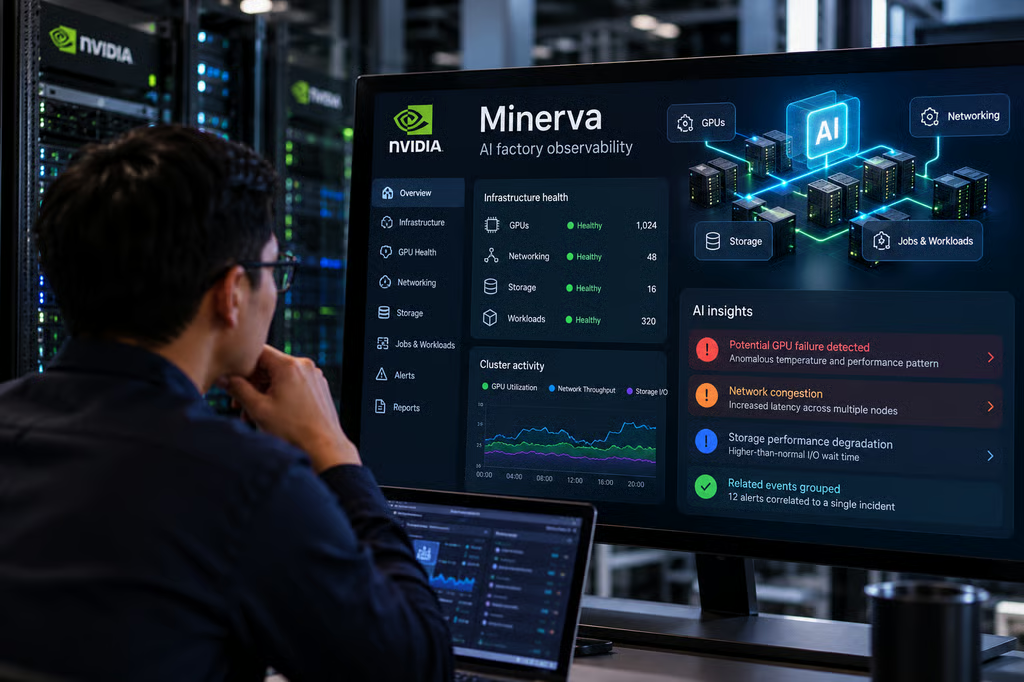
Nvidia introduced Minerva on Oct. 22, an AI-powered observability platform designed to help data center operators detect GPU cluster problems before they disrupt workloads. The system connects infrastructure and workload data, identifies unusual behavior, and groups related alerts to help engineers locate the source of a problem.
The launch targets a growing challenge for AI factories: monitoring thousands of interconnected components without overwhelming operations teams with alerts. Nvidia says Minerva can predict emerging failures and recommend fixes, although it has not published benchmarks establishing how accurately those capabilities work.
How Nvidia Minerva detects GPU cluster problems
According to Nvidia's announcement, Minerva collects telemetry from GPUs, networking equipment, storage, job schedulers, and AI workloads.
The platform organizes that information into a dynamic knowledge graph connecting GPUs, SuperNICs, switches, cables, and the jobs running across them.
Minerva then uses supervised and unsupervised machine learning to analyze billions of data points per hour. It learns normal operating patterns, detects previously unseen anomalies, predicts emerging failures, and correlates related events based on infrastructure connections.
A slow training job, for example, could be traced to an underperforming storage device or networking component rather than treated as an isolated application problem.
Nvidia says Minerva can consolidate multiple warnings into one incident with a likely root cause, reducing the number of alerts engineers must investigate separately.
Similar alert-correlation challenges are being addressed by AI agents for IT operations, including SolarWinds Avior, which also aims to connect infrastructure signals and automate investigations.
Minerva includes an AI assistant that lets operators ask questions about cluster health in natural language and receive recommended remediation steps.
Teams can apply those recommendations manually or connect Minerva to infrastructure APIs and external systems to automate certain actions.
However, Nvidia has not detailed the approval controls, rollback mechanisms, or safeguards governing automated changes to production infrastructure.
The company also has not specified supported GPU generations, scheduler configurations, or compatibility with non-Nvidia hardware.
Those details could affect how readily enterprises integrate Minerva into existing environments.
What eWeek found: Four tests before trusting Minerva
Nvidia named AI infrastructure provider IREN as an existing Minerva user.
"NVIDIA Minerva gives our operations team one view across the network, the GPUs and the jobs running on them, so we focus more on proactive maintenance rather than troubleshooting," said Denis Skrinnikoff, IREN's chief technology officer, in Nvidia's announcement.
Seven other organizations plan to deploy the platform: Aolani, Bitdeer AI, IBM, Jio, Lambda, Quake AI, and Tesla.
Dell Technologies, Lenovo, and Supermicro also plan to offer Minerva through their AI factory operations portfolios.
Those commitments establish industry interest, but Nvidia has not released Minerva-specific figures for detection accuracy, false positives, or average time to resolution.
Four tests would help infrastructure teams evaluate whether the platform delivers measurable improvements:
- Measure alert accuracy. Compare Minerva's warnings against confirmed incidents. Track false positives and failures the system misses, not just the number of alerts it consolidates.
- Test root-cause identification. Introduce known GPU, networking, and storage faults in a controlled environment. Check whether Minerva identifies the affected component or merely groups related symptoms.
- Measure recovery time. Compare incident detection, diagnosis, and resolution times with existing monitoring tools. Faster alert generation alone does not establish faster recovery.
- Validate automation safeguards. Confirm which actions require approval, whether changes can be reversed, and how administrators prevent automated remediation from disrupting healthy workloads.
These tests are proposed evaluation criteria, not results from an eWeek assessment of Minerva.
The distinction between detecting a fault and safely resolving it also appears in recent work on AI agent permissions, where administrators must define which actions automated systems can take.
Minerva's potential value depends on whether its recommendations remain accurate across different GPU configurations, workloads, and infrastructure failures.
Nvidia has not disclosed pricing or a general availability date, and its announcement does not establish compatibility with every enterprise environment.
IREN's deployment could eventually provide useful operational evidence, but Nvidia has not published detailed performance results from that installation.
Until those results are available, enterprises have a documented architecture and a list of interested partners, but not enough evidence to quantify Minerva's effect on GPU uptime or troubleshooting costs.
Also read: ServiceNow and Nvidia's Arc introduces an enterprise AI agent that can carry out extended workplace assignments under IT-defined permissions.