







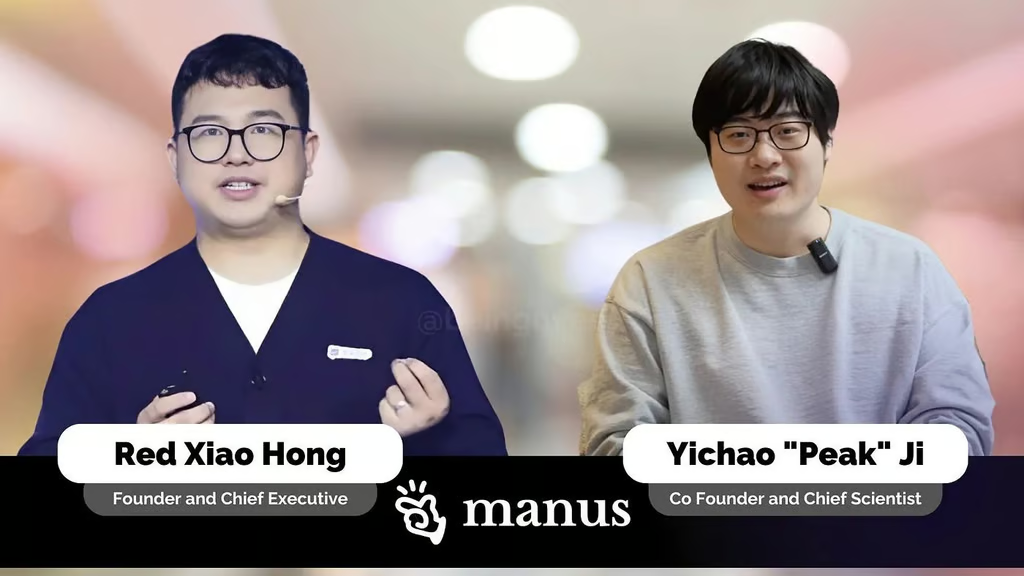
The founders of Manus, a high-flying startup specializing in AI agents, have found themselves at the center of a geopolitical tug-of-war.
CEO Xiao Hong and Chief Scientist Ji Yichao were recently summoned to Beijing for meetings with the National Development and Reform Commission (NDRC). According to the Financial Times, the two executives, who are based in Singapore, were questioned regarding potential violations of foreign direct investment rules before being told they are not permitted to leave China.
While they remain free to move within the country’s borders, the exit restriction serves as a warning from Chinese regulators who are increasingly protective of homegrown tech.
Why Manus matters
Manus isn’t your average chatbot company. It builds autonomous AI agents capable of handling complex digital chores like writing code, analyzing massive datasets, and managing files, without needing a human to hold its hand.
Though the company is now headquartered in Singapore, its roots are firmly in China. It was founded in 2022 as Beijing Butterfly Effect Technology before relocating its core team and operations to Singapore last year. That move paved the way for Meta to snap up the firm in December 2025 for an estimated $2 billion.
Beijing regulators are reportedly concerned that this relocation-and-acquisition strategy could serve as a blueprint for other Chinese tech talent seeking to bypass domestic oversight. Per the Financial Times, officials have expressed fears about “selling young crops” to foreign rivals in strategic sectors such as artificial intelligence.
A ‘messy’ investigation
The investigation, spearheaded by China’s Ministry of Commerce and the NDRC, is examining whether the sale violated export controls or reporting requirements regarding ownership changes.
According to the Wall Street Journal, officials are specifically scrutinizing whether the relocation to Singapore and the subsequent sale to Meta posed risks to user data or flouted laws on the “export of technology.”
One source told the Financial Times that while serious penalties for these specific violations are rare, an “extreme outcome” could involve trying to unwind the entire deal. However, they noted such a move would be “messy” given that Meta has already begun folding Manus’s 100-person team and software into its own platform.
Despite the regulatory heat, Meta is standing by the acquisition. The social media giant views Manus as a key piece of its “Superintelligence Labs” division, led by Scale AI’s Alexandr Wang.
Regarding the ongoing inquiry in China, a Meta spokesperson stated: “The transaction complied fully with applicable law. We anticipate an appropriate resolution to the inquiry.”
This move marks the first time Beijing has used exit bans to directly target executives involved in a deal with a major US tech firm. It highlights the growing desperation on both sides of the Pacific to retain AI talent. As the US tightens chip export, China is countering by making it harder for its “young crops” of engineers to take their talents and their code to Silicon Valley.
Meanwhile, in Shenzhen, robot “volunteers” are already guiding visitors, handing out supplies, and testing how AI could power real-world public services.